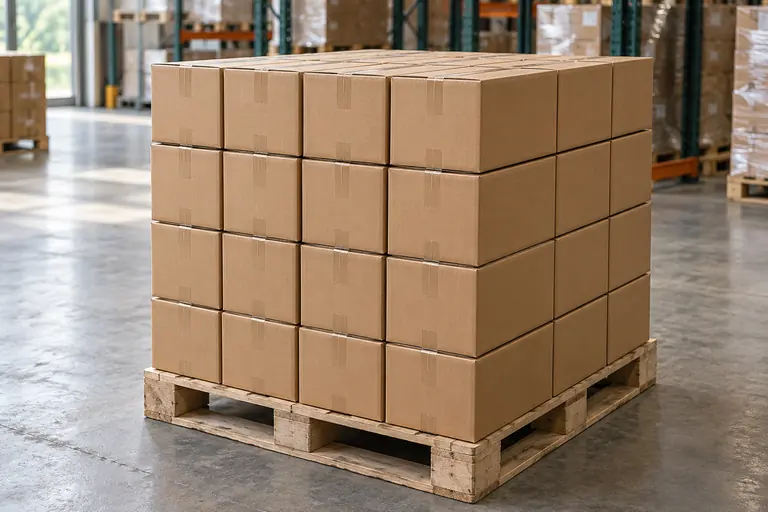
TI means cartons in one pallet layer; HI means the number of layers. For a build with the same number of cartons in every complete layer, TI × HI gives the total cartons on the pallet. A TI of 8 and an HI of 4 therefore describe 32 cartons—not a stack that is 4 centimetres high.
The useful next question is how that count was obtained. You need the packed carton footprint, the pallet footprint, the available cargo height and the permitted stacking arrangement. A numerical count alone does not show where the cartons sit or whether the packaging can support the load.
What do TI and HI mean on a pallet?
| Measure | Meaning | Example |
|---|---|---|
| TI | Count of cartons in one layer | 8 cartons per layer |
| HI | Count of layers in the build | 4 complete layers |
| TI × HI | Total cartons when each layer has the stated count | 8 × 4 = 32 cartons |
| Loaded height | Physical height, with its measurement convention stated | 100 cm cargo; 114 cm including an illustrative 14 cm pallet |
Some systems use “cases” rather than “cartons.” State what the counted unit is. A carton containing 12 retail units still counts as one carton when describing the pallet layout; retail-unit quantity is a separate calculation.
How to calculate TI and HI for a uniform carton size
1. Compare the two upright grid orientations
For rectangular cartons placed upright with no overhang, a simple grid estimate is:
- Direction A: floor(pallet length ÷ carton length) × floor(pallet width ÷ carton width).
- Direction B: floor(pallet length ÷ carton width) × floor(pallet width ÷ carton length).
“Floor” means round each division down before multiplying. A fractional carton cannot be credited as a complete carton. Take the larger count only if both orientations are permitted. These two grids do not search all mixed-orientation or interlocking patterns, so the result is not a proof of the global maximum.
2. Work out the height available to the cartons
If you know the clear cargo height above the pallet deck, divide that height by the upright carton height and round down. If the limit is measured from the bottom of the pallet, subtract the pallet's actual height and any required allowances first:
Height-limited HI = floor((overall height limit − pallet height − allowances) ÷ carton height).
Then check whether weight, packaging strength, receiving rules or another operating limit requires fewer layers. A height calculation is only one constraint.
Worked example: six or eight cartons per layer?
Use a 120 × 80 cm pallet and upright cartons measuring 40 × 30 × 25 cm. Allow no overhang, use a uniform direction in each candidate grid, and assume 100 cm is available to the cartons above the deck. These are illustrative inputs, not a recommendation for a particular shipment.
| Check | Calculation | Result |
|---|---|---|
| Direction A | floor(120 ÷ 40) × floor(80 ÷ 30) = 3 × 2 | 6 cartons/layer |
| Direction B | floor(120 ÷ 30) × floor(80 ÷ 40) = 4 × 2 | 8 cartons/layer |
| Layers by cargo height | floor(100 ÷ 25) | 4 layers |
| Total, better permitted uniform grid | 8 × 4 | 32 cartons |
In the StowMetric pallet configuration calculator, enter carton dimensions 40, 30 and 25 with the unit set to cm; pallet length 120 cm, pallet width 80 cm and available cargo height 100 cm. The tool's maximum-height input is the space for cargo, so exclude the pallet base from that value.
If the available rotation is restricted to Direction A, the layer count is 6 instead. With four full layers that is 24 cartons. Do not choose the eight-carton grid simply because its arithmetic result is larger.
Why “maximum pallet height” can change the answer
Now keep the same cartons but suppose a receiving instruction limits the entire loaded unit to 100 cm, and the actual pallet is 14 cm high. With no additional allowance in this illustrative comparison, cargo height is 86 cm. Only floor(86 ÷ 25) = 3 full layers fit, so the eight-carton grid gives 24 cartons. The resulting loaded height is 14 + 3 × 25 = 89 cm.
The difference between 24 and 32 cartons comes entirely from the height convention. Record whether a quoted limit includes the pallet, top protection and other materials before using it in a calculator.
A weight limit may allow fewer layers than a height limit
For a separate example, assume each carton weighs 6 kg, the pallet weighs 20 kg and the allowed gross unit weight is 180 kg. One eight-carton layer weighs 48 kg. The weight-limited layer count is floor((180 − 20) ÷ 48) = 3. Three layers weigh 164 kg including the pallet; four would weigh 212 kg.
In that example, use the lower layer count even if four layers fit by height. Add any other packaging weight to the check. Do not confuse a gross-unit limit with a cargo-only limit, or assume that a pallet rating also verifies carton compression strength. StowMetric's current free pallet tool does not perform this weight check; it is shown here as a separate manual calculation.
TI × HI is a count, not the whole pallet instruction
Two builds may have the same count but different arrangements. A usable instruction should include the layer diagram, carton orientation, the actual loaded dimensions, the approved layer count and any packaging or handling requirements. Record a revision so the receiving team and the loading team refer to the same build.
For a partial top layer, do not report the full-layer multiplication as the actual shipment count. For example, three complete layers of eight cartons plus five on the top contain 29 cartons: 3 × 8 + 5. State the partial layer explicitly using your customer's required convention.
For mixed carton sizes, different supporting faces or interlocking patterns, the simple grid calculation is insufficient. Discuss the actual requirements through StowMetric pallet load planning; confirm the available workflow before assuming that any particular pattern can be generated.
TI/HI questions answered
Does HI mean the pallet height in inches or centimetres?
No. HI is a layer count. Record physical cargo height and overall loaded height separately, with units and a clear statement of whether the pallet is included.
Is there one standard loaded height for every pallet?
No single height is suitable for all shipments. The equipment, warehouse, receiving instructions, packaging and handling conditions determine the applicable limit. Obtain it for your operation rather than borrowing a number from a generic example.
Can I divide pallet area by carton area to get TI?
That ratio is an area ceiling, not a layout. Complete rectangular footprints must fit within the edges under the allowed orientations. Check actual arrangements, such as the two uniform grids shown here.
Does a larger TI always make a better pallet?
No. The arrangement must also satisfy packaging, handling and operating requirements. A count calculator does not approve stability, securing or carton strength.
Can I reuse the same TI/HI after packaging changes?
Recheck it when packed dimensions, weight, pallet size, permitted orientation or operating limits change. Even a small measurement change can remove an entire row or layer.
Reference and next step
SPS Commerce's TI/HI explanation provides additional terminology context. The calculations and drawings in this guide are StowMetric's own illustrative examples; they do not certify a pallet build.
Try your dimensions in the free pallet calculator, then keep the input assumptions with the result. When those assumptions do not describe your cargo, use the estimate to prepare a more detailed planning discussion.